Dynamically balances tech exposure to magnify upside and mitigate downside through income

KQQQ Comparisons

Since inception, the Kurv Tech Titans Select (KQQQ) has outperformed some of its largest income-focused as well as growth-focused peers that offer tech exposure.

Total Return

7/22/2024 – 11/28/2025
Volatility
Return/Vol
Distribution
32.71%
KQQQ
15-20 large tech
Actively managed
24.69%
1.33
17.21%*
29.57%
VGT
IT Index
Passive index
27.68
1.07
0.46%
29.26%
QQQ
Nasdaq 100
Passive index
23.34%
1.25
0.45%
28.18%
QQQI
Nasdaq 100
Actively managed
19.72%
1.43
13.90%
23.97%
JEPQ
Nasdaq 100
Actively managed
18.94%
1.27
9.70%
23.44%
IQQQ
Nasdaq 100
Passively managed
20.45%
1.15
7.46%
20.85%
FEPI
FANG & Innovation
Premium Income
22.03%
0.95
25.08%
16.7%
QTEC
Nasdaq 100
Passive index
29.55%
0.57
–%
12.73%
JEPI
S&P 500
Passively managed
12.55%
1.01
7.18%

KQQQ = Kurv Tech Titans Select ETF  |  QQQ = Invesco QQQ Trust  |  QTEC = First Trust Nasdaq 100 Tech Sector Index Fund  |  VGT = Vanguard Information Technology Index Fund ETF  I  JEPQ = JP Morgan Nasdaq Equity Premium Income ETF  |  JEPI = JPMorgan Equity Premium Income ETF  |  QQQI = NEOS Nasdaq-100 High Income ETF  |  IQQQ = ProShares Nasdaq-100 High Income ETF  |  FEPI = REX FANG & Innovation Equity Premium Income ETF

Performance is historical and does not guarantee future results. Current performance may be lower or higher than quoted. Investment returns and principal value of an investment will fluctuate so that an investor's shares, when redeemed, may be worth more or less than their original cost. All funds are managed differently and do not react the same to economic or market events. The investment objectives, strategies, policies or restrictions of other funds may differ and more information can be found in their respective prospectuses. Therefore, we generally do not believe it is possible to make direct fund to fund comparisons in an effort to highlight the benefits of a fund versus another similarly managed fund.

*The Fund currently expects, but does not guarantee, to make distributions on a monthly basis. These distributions may exceed the Fund's income and gains for the Fund's taxable year. Distributions in excess of the Fund's current and accumulated earnings and profits will be treated as a return of capital. Distributions rates caused by unusually favorable market conditions may not be sustainable. Such conditions may not continue to exist and there should be no expectation that this performance may be repeated in the future. Please see the Supplemental Tax Information section of the website for more information on the distribution composition including the estimated return of capital. Per the Fund's most recent 19a-1 notice, the estimated per share composition of the distribution includes return of capital (ROC) of 90%.A final determination of the tax character of distributions paid by the Funds will not be known until the completion of the Funds fiscal year and there can be no assurance as to the portions of each Fund's distributions that will constitute return of capital and/or dividend income. The final determination of the tax character of distributions paid by the Funds will be reported to shareholders on their Form 1099-DIV.

As of November 28, 2025. Volatility annualized since inception. Source: Morningstar, Kurv

Why focus on the largest technology companies?

The largest technology companies continue to be the growth engine of the economy. Their size allowed certain market dominance and pricing advantages globally. Continuous advancement of artificial intelligence, in forms like large language models, requires large amounts of training data and even larger amounts of computational power. At Kurv, we believe these titans are well positioned into the future.

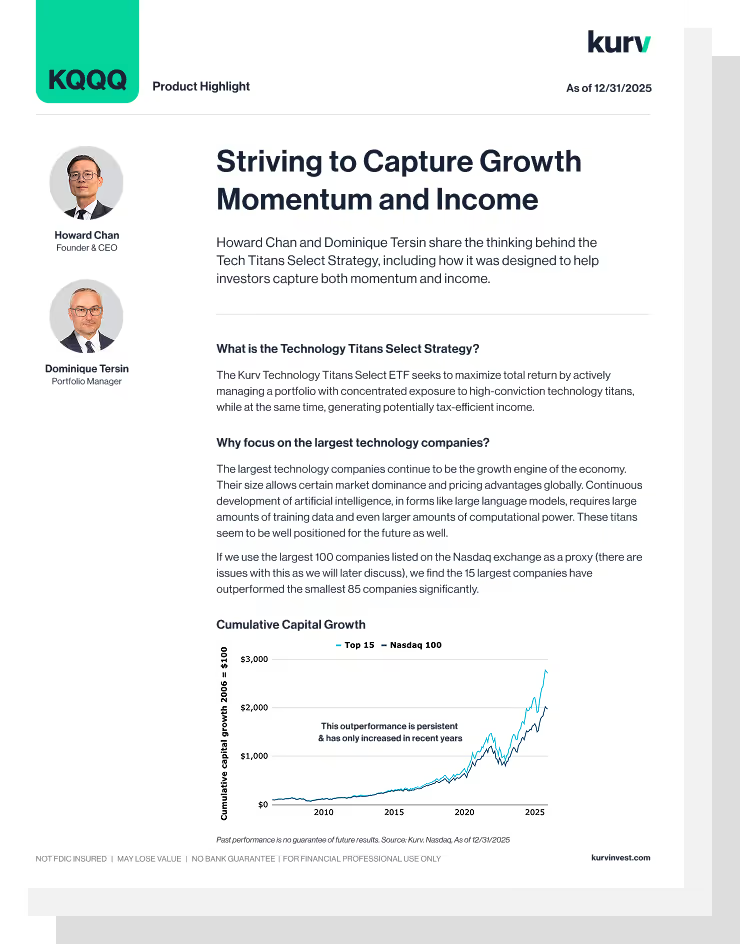
If we use the top 100 companies listed on the Nasdaq exchange as a proxy, the top 15 largest companies have outperformed the bottom 85 companies significantly

Titans continue to drive returns in tech 

Past performance is no guarantee of future results. Source: Kurv Investment Data as of 7/25/2025.

How it works

Smart security selection

  • Removing non-technology companies helps deliver purer exposure to the top technology growth stocks
  • Physical and/or synthetic company exposure

Momentum weighting

  • To seek maximum growth, names are weighted based on momentum signals

Potential downside mitigation with income

  • Writing covered calls seeks to generate income on a stock with limited upside potential or low price momentum
  • Also serves as potential downside mitigation

Team

Kurv Yield Premium Strategy ETFs are managed by investment professionals with an average of more than 20 years of experience, having worked at the largest firms such as PIMCO, Goldman Sachs, and JP Morgan

Howard Chan
Chief Executive Officer & Founder

Dominique Tersin
Investment Strategist

Gery Sadzewicz
Gery Sadzewicz
Chief Compliance Officer

How to buy Kurv ETFs

Investors may purchase Kurv ETFs at most online brokerages or through U.S. stock exchanges.

Kurv Investment Management is not affiliated with these financial service firms. Their listing should not be viewed as a recommendation or endorsement. By clicking the links below, you are leaving this website and going to a third-party site. Kurv Investment Management is not responsible for content on third-party sites.

This Fund is not affiliated with these financial service firms. Their listing should not be viewed as a recommendation or endorsement.

Disclosures

An investor should consider the investment objectives, risks, charges, and expenses of the Fund carefully before investing. To obtain a prospectus containing this and other information, please call 1-888-393-KURV (5878). Read the prospectus carefully before investing by clicking here.

Past performance is no guarantee of future results. The performance data quoted here represents past performance. Current performance may be lower or higher than the performance data quoted above. Investment return and principal value will fluctuate, so that shares, when redeemed, may be worth more or less than their original cost.

Short term performance, in particular, is not a good indication of the fund’s future performance, and an investment should not be made solely on returns. The ETFs shown are not meant to be a representative sample of all equity income ETFs or tech ETFs. For standardized performance current to the most recent month end for KQQQ, please call (833) 955-5878 or go to KQQQ Fund page of this site.

All funds shown are managed differently and do not react the same to economic or market events. The investment objectives, strategies, policies or restrictions of other funds may differ, and more information can be found in their respective prospectuses. Therefore, we generally do not believe it is possible to make direct fund comparisons in an effort to highlight the benefits of a fund versus another. More information regarding the differences in these ETFs investment strategies shown on the later page.
Source: US Bank, Morningstar 2025.

KQQQ (as of 8/31/2025):
30-Day SEC Yield: 1.29%, 30-Day Unsubsidized SEC Yield: 1.29%.
Gross Expense Ratio 1.08%, Net Expense Ratio 1.08% with AFF&E, 0.99% without AFF&E.

Volatility is a statistical measurement of the degree of variability of the return of a security or market index. "Return divided by volatility" is a widely used metric for calculating risk-adjusted return to compare return for volatility risk taken.

Kurv Investment Management LLC is a Registered Investment Adviser. Advisory services are only offered to clients or prospective clients where Kurv Investment Management LLC and its representatives are properly licensed or exempt from licensure. SEC registration does not constitute an endorsement of the firm by the Commission, nor does it indicate that the advisor has attained a particular level of skill or ability. Be sure to first consult with a qualified financial adviser and/or tax professional before implementing any strategy. The Fund seeks maximum total return, consistent with prudent investment management.This presentation is not intended to provide investment, tax, or legal advice.

This presentation is solely for informational purposes and does not intend to make an offer or solicitation for the sale or purchase of any specific securities, investments, or investment strategies. These materials are made available on an “as is” basis, without representation or warranty. The information contained in these materials has been obtained from sources that Kurv Investment Management LLC. believes to be reliable, but accuracy and completeness are not guaranteed. This information is only current as of the date indicated and may be superseded by subsequent market events or for other reasons. Neither the author nor Kurv Investment Management LLC. undertakes to advise you of any changes in the views expressed herein.

This material must be preceded or accompanied by a prospectus. An investor should carefully consider a Fund’s investment objective, risks, charges, and expenses before investing.

Distribution Rate: The annual yield an investor would receive if the most recent fund distribution remained the same going forward. The distribution yield represents a single distribution from the Fund and is not a representation of the Fund's total return. The distribution yield is calculated by multiplying the most recent distribution by 12 in order to annualize it, and then dividing by the Fund's NAV.

Comparative ETF Discussion

Past performance does not guarantee future results. Short term performance, in particular, is not a good indication of the fund’s future performance, and an investment should not be made solely on returns To view the standardized performance of each ETF, please click on their corresponding link shown below.

Investors should carefully consider the investment objectives and risks as well as charges and expenses of the ETF before investing. The summary and full prospectuses contain this and other information about the ETF. Read the prospectus carefully before investing. Links to each ETFs corresponding documents are listed below.

Short term performance, in particular, is not a good indication of the fund’s future performance, and an investment should not be made solely on returns. The ETFs shown are not meant to be a representative sample of all equity income ETFs or tech ETFs. For standardized performance current to the most recent month end for KQQQ, please call (833) 955-5878 or go to KQQQ Fund page of this site.

Distribution Rate: The annual yield an investor would receive if the most recent fund distribution remained the same going forward. The distribution yield represents a single distribution from the Fund and is not a representation of the Fund's total return. The distribution yield is calculated by multiplying the most recent distribution by 12 in order to annualize it, and then dividing by the Fund's NAV. Liquidity: Because these Funds are ETFs, only a limited number of institutional investors (known as “Authorized Participants”) are authorized to purchase and redeem shares directly from the Fund. In addition, there may be a limited number of market makers and/or liquidity providers in the marketplace. To the extent either of the following events occur, shares of the Fund may trade at a material discount to their net asset value (“NAV”) per share and possibly face delisting: (i) Authorized Participants exit the business or otherwise become unable to process creation and/or redemption orders and no other Authorized Participants step forward to perform these services, or (ii) market makers and/or liquidity providers exit the business or significantly reduce their business activities and no other entities step forward to perform their functions.Guarantees or Insurance: An investment in the Fund is not insured or guaranteed by the Federal Deposit Insurance Corporation or any other government agency.

Comparing KQQQ ETF with the other funds is useful for investors seeking to understand the different approaches to gaining exposure to the technology sector and the Nasdaq-100 index. While funds like QQQ and QTEC are passive, index-tracking ETFs, and VGT focuses on the broader information technology sector, KQQQ is an actively managed ETF that utilizes a momentum-based weighting strategy and covered call options for potential downside mitigation and income generation. Unlike the other covered call funds (QQQI, IQQQ, JEPQ, and JEPI), which generally write covered calls on their entire portfolio, KQQQ uses a dynamic strategy, selectively writing calls on stocks with limited upside or low price momentum.

The ETFs shown are not meant to be a representative sample of all equity income ETFs. All funds shown are managed differently and do not react the same to economic or market events. The investment objectives, strategies, policies or restrictions of other funds may differ, and more information can be found in their respective prospectuses. Therefore, we generally do not believe it is possible to make direct fund comparisons in an effort to highlight the benefits of a fund versus another.

The Fund seeks maximum total return, consistent with prudent investment management. An investment in the Fund entails risk, including the loss of principal. The Fund is not a complete investment program and investors should review the risks associated with the Fund before investing. The Fund is an actively managed portfolio, and the portfolio managers will apply investment techniques and risk analyses that may not produce the desired result. There can be no guarantee that the Fund will meet its investment objective. As an ETF, the Fund is exposed to the additional risks, including: (1) concentration risk associated with Authorized Participants, market makers, and liquidity providers. Such concentration could negatively impact liquidity; (2) costs risks associated with frequent trading; (3) market prices may differ than the Fund’s net asset value; and (4) liquidity risk due to a potential lack of trading volume.

Invesco QQQ (QQQ)

Invesco QQQ (QQQ) is an exchange-traded fund based on the Nasdaq-100 Index®. The Fund will, under most circumstances, consist of all of stocks in the Index. The Index includes 100 of the largest domestic and international non-financial companies listed on the Nasdaq Stock Market based on market capitalization. The Fund and the Index are rebalanced quarterly and reconstituted annually.

For standardized performance and prospectus, Click here.
Expense Ratio: 0.20% Fund Assets as of 8/31/2025 $365B 30-Day SEC Yield: 0.48%

Vanguard Information Technology ETF (VGT)

Vanguard Information Technology ETF (VGT) seeks to track the performance of the MSCI US Investable Market Information Technology 25/50 Index. This index measures the investment return of information technology stocks in the U.S.. It is classified as aggressive are subject to extremely wide fluctuations in share prices. The unusually high volatility associated with these funds may stem from one or more of the following strategies: a concentration of fund holdings in a relatively low number of individual stocks, or in a particular sector of the stock market, or in a particular geographical region of the world; a heavy emphasis on small-capitalization stocks or growth stocks with relatively high market valuations; holdings of international stocks or bonds, which are subject to price declines caused by changes in the value of the U.S. dollar against foreign currencies; or investments in bonds that have exceptionally long average durations, whose prices are highly sensitive to changes in interest rates.

For standardized performance and prospectus: Click here
Expense Ratio: 0.09% Fund Assets as of 8/31/2025 $116.8B 30-Day SEC Yield: 0.42%

First Trust Nasdaq 100 Tech Sector Index Fund (QTEC)

First Trust Nasdaq 100 Tech Sector Index Fund (QTEC) aims to track the NASDAQ-100 Technology Sector Index. This equal-weighted index comprises technology companies from the broader Nasdaq-100 Index, offering concentrated exposure to the technology sector. A fund that invests in securities included in or representative of an index will hold those securities regardless of investment merit and the fund generally will not take defensive positions in declining markets.

For standardized performance and prospectus: Click here
Expense Ratio: 0.61% Fund Assets as of 8/31/2025 $2.7B 30-Day SEC Yield: 0.00%

NEOS Nasdaq-100® High Income ETF (QQQI)

NEOS Nasdaq-100® High Income ETF (QQQI) seeks to distribute high monthly income generated from investing in the constituents of the Nasdaq-100® Index and implementing a data-driven call option strategy. Because the Nasdaq-100® Index has been concentrated in the information technology sector, the Fund may be sensitive to changes in, and its performance may depend to a greater extent on, the overall condition of the information technology sector.

For standardized performance and prospectus: Click here
Expense Ratio: 0.68% Fund Assets as of 8/31/2025 $4.2B 30-Day SEC Yield: 0.07%

ProShares Nasdaq-100 High Income ETF (IQQQ)

ProShares Nasdaq-100 High Income ETF (IQQQ) seeks to provide high income and long-term growth through a strategy that combines a long position in the Nasdaq-100 Index with a daily covered call writing strategy. Essentially, it aims to generate income from call options on the Nasdaq-100 while still providing exposure to the index's overall performance. Unlike monthly covered call ETFs, IQQQ's daily options strategy has a different risk profile. While it may aim to capture more of the upside, it can also be more susceptible to rapid, short-term market movements.

For standardized performance and prospectus: Click here
Expense Ratio: 0.55% Fund Assets as of 8/31/2025 $230.1M 30-Day SEC Yield: 0.32%

JP Morgan Nasdaq Equity Premium Income ETF (JEPQ)

JP Morgan Nasdaq Equity Premium Income ETF (JEPQ) seeks to deliver monthly distributable income and Nasdaq 100 exposure with less volatility. JEPQ sacrifices potential capital gains during strong Nasdaq 100 rallies by selling call options. The fund is heavily concentrated in the technology and growth stocks that dominate the Nasdaq 100, which can lead to higher volatility than a broader market fund.JEPQ uses Equity-Linked Notes (ELNs) to execute its options strategy, which exposes it to the risk that the issuer of these notes may default.

For standardized performance and prospectus: Click here
Expense Ratio: 0.35% Fund Assets as of 8/31/2025 $28.5B 30-Day SEC Yield: 9.47%

JP Morgan Equity Premium Income ETF (JEPI)

JP Morgan Equity Premium Income ETF (JEPI) invests in a portfolio of large-cap stocks and sells call options on the S&P 500 Index to generate income. Unique risks include Capped Upside: JEPI limits potential gains during strong bull markets due to the sale of call options. Its performance depends on the skill of the fund's managers. The fund uses Equity-Linked Notes, which carry liquidity and counterparty risk.

For standardized performance and prospectus: Click here
Expense Ratio: 0.35% Fund Assets as of 8/31/2025 $41.3B 30-Day SEC Yield: 7.27%

REX FANG & Innovation Equity Premium Income ETF (FEPI)

REX FANG & Innovation Equity Premium Income ETF (FEPI) is an actively managed exchange-traded fund (“ETF”) that seeks current income while maintaining the opportunity for exposure to the share price (i.e., the price returns) of the securities of the companies comprising the Solactive FANG Innovation Index (the “Index”). The Fund seeks to employ its investment strategy regardless of whether there are periods of adverse market, economic, or other conditions and will not seek to take temporary defensive positions during such periods. As further described below, the Fund uses a covered call strategy to provide income and exposure to the share price returns of the companies comprising the Index, subject to a limitation on the opportunity to profit from an increase in the share price above the strike price of written options. The Fund’s options contracts provide: exposure to the share price returns (subject to a limitation on the opportunity to profit from an increase in the share price above the strike price of written options), and current income from the option premiums.

For standardized performance and prospectus, Click here
Expense Ratio: 0.65% Fund Assets as of 11/28/2025 $579.3M 30-Day SEC Yield: -0.40%

Risks

KQQQ Risks: The Fund will invest in the equity securities of, or derivative instruments (e.g. options) relating to, Technology Companies. Accordingly, the performance of the Fund could be negatively impacted by events affecting this sector. Market or economic factors impacting technology companies and companies that rely heavily on technological advances could have a significant effect on the value of the Fund’s investments. The value of equity securities, such as common stocks and preferred securities, may decline due to general market conditions which are not specifically related to a particular company or to factors affecting a particular industry or industries. Equity securities generally have greater price volatility than fixed income securities. When the Fund or an Underlying Kurv ETF invests in fixed income securities or fixed income ETFs, the value of your investment in the Fund will fluctuate with changes in interest rates. Typically, a rise in interest rates causes a decline in the value of fixed income securities. The Fund may engage in certain transactions, such as options, that may give rise to leverage, magnifying gains and losses and causing the Fund to be more volatile than if it had not been leveraged. This means that leverage entails a heightened risk of loss. Because the Fund is “non-diversified,” it may invest a greater percentage of its assets in the securities of a single issuer or a smaller number of issuers than if it was a diversified fund. As a result, a decline in the value of an investment in a single issuer or a smaller number of issuers could cause the Fund’s overall value to decline to a greater degree than if the Fund held a more diversified portfolio.

Synthetic Long Risks: The Fund will also invest in the Kurv Yield Premium ETFs. The Fund may gain long exposure via purchasing shares of individual companies or creating a synthetic long position. To achieve a synthetic long exposure, the Fund buys call options of a technology company and, simultaneously, sells put options of the same company to try to replicate the price movements of the underlying company. The combination of the long call options and sold put options seek to provide the Fund with investment exposure to the underlying company for the duration of the application option exposure. Please note that the synthetic long and underlying equity security may not attain a 1:1 correlation. The notional exposure to an underlying company when the Fund buys put and call options directly will not exceed 150% of net asset value (when obtaining exposure to an underlying company through an Underlying Kurv Yield Premium ETF, notional exposure will be limited to 100% of net asset value). The call options the Fund buys and the put options it sells will be at the same strike price and have the same expiration, however, the amount may differ.

Underlying Kurv Yield Premium ETF Risks: The Fund will invest in Underlying Kurv ETFs, so the Fund’s investment performance is likely to be related to the performance of the Underlying Kurv ETFs. An investment in the Fund entails more costs and expenses than the combined costs and expenses of direct investments in the Underlying Kurv ETFs. Each Underlying Kurv ETF invests in options contracts which are based on the value of its Underlying Security and subjects each ETF to the risks associated with the industry of the corresponding Underlying Issuer. Each Underlying Kurv ETF employs a strategy of selling call option contracts, limiting its participation in the value increase of the Underlying Security during the call period. Should an Underlying Security’s value increase beyond the sold call options’ strike price, the Underlying Kurv ETF may not experience the same extent of increase, potentially underperforming the Underlying Security and experiencing a NAV decrease, especially given its full exposure to any value decrease of the Underlying Security over the call period. The Underlying Kurv ETFs aim to provide monthly income, although distributions are not guaranteed, and amounts may vary. Monthly distributions may consist of capital returns, reducing each ETFs NAV and trading price over time which could lead to significant losses for investors (including the Fund). Repetitive payment of distributions may erode the Underlying Kurv ETFs NAV and trading price over time, which could result in notable losses for the Fund. The continuous application of each Underlying Kurv ETFs call writing strategy impacts its ability to participate in the positive price returns of its Underlying Security, which in turn affects each Underlying Kurv ETF’s returns both during the term of the sold call options and over longer time frames. Some securities held by the Underlying Kurv ETFs, including options contracts, may be difficult to sell or be illiquid, particularly during times of market turmoil. This risk is greater for the Underlying Kurv ETFs as each will hold options contracts on a single security, and not a broader range of options contracts.